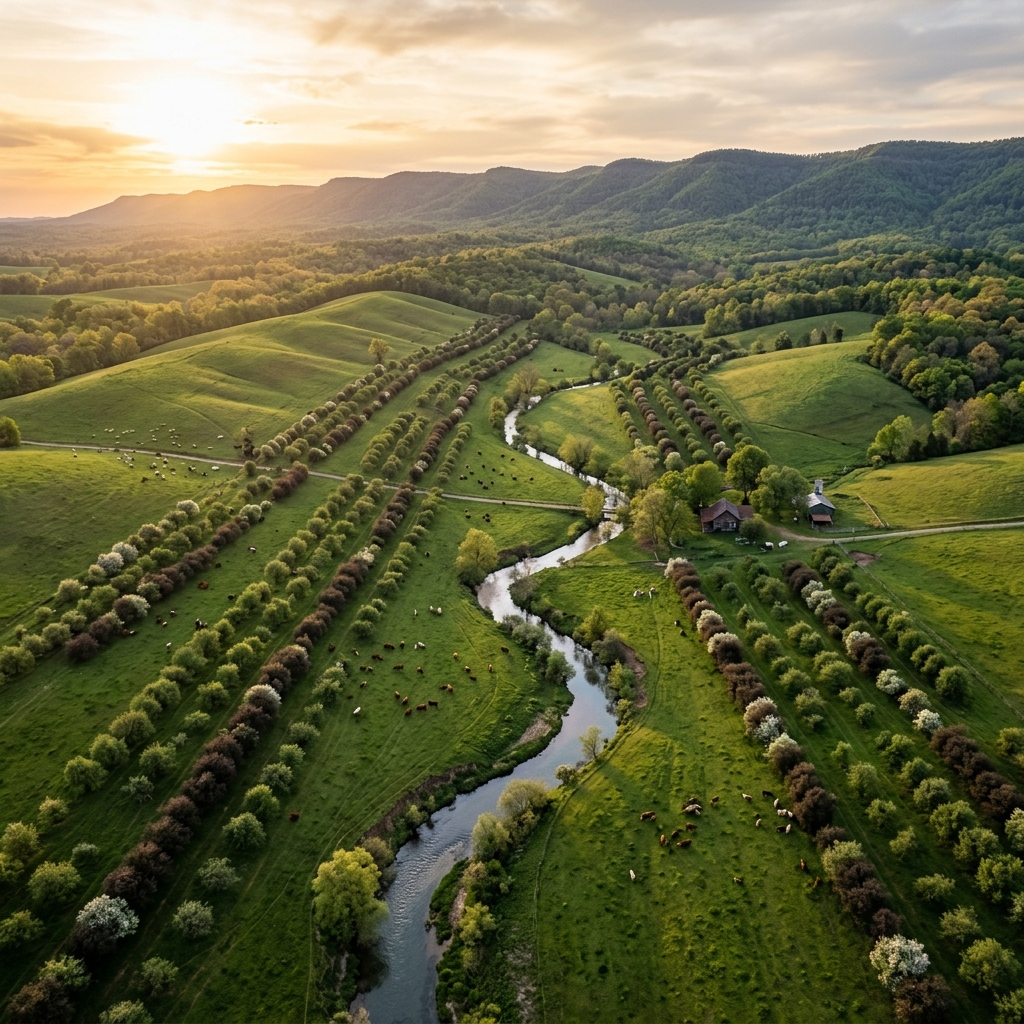
The Land
Rolling Ozark highlands, a spring-fed creek, and the deep soil of Washington County — the foundation of everything we build.
The Practice
What is Silvopasture?
Silvopasture is the intentional integration of trees, forage crops, and livestock on the same parcel of land. Rather than separating forestry and grazing, silvopasture combines them to create a mutually beneficial ecosystem. It's one of the oldest and most productive agricultural systems in the world — and one of the most effective at building soil health and sequestering carbon.
At Cur Dog Creek, heritage apple and Service Trees provide canopy and fruit production while the pasture underneath supports managed grazing of American Guinea Hogs and Mangalica Pigs, driving nutrient cycling.
Closed-Loop System
Every Output Feeds the Next Stage
Orchard
Heritage fruit trees produce crab apples and Service Tree fruit (sorbs)
Cidery
Fruit is pressed into heritage ciders and Apfelwein
Swine
Pomace waste feeds American Guinea Hogs and Mangalica Pigs on the silvopasture
Soil
Livestock cycling enriches soil, feeding the next season's growth
The cycle repeats — a self-reinforcing loop that grows stronger each year.
The Namesake
Cur Dog Creek
A spring-fed creek runs through the heart of the property, giving the operation its name and providing a natural water source for the silvopasture system. The creek supports the ecosystem — from irrigation to wildlife habitat — and connects the land to the broader Ozark watershed.
The Region
Washington County, Arkansas
Nestled in the Ozark Highlands of Northwest Arkansas, Washington County offers deep limestone-based soils, abundant rainfall, and a climate uniquely suited to heritage apple varieties and temperate silvopasture systems.
The region's growing agricultural renaissance — fueled by farm-to-table culture and a thriving local economy — makes it an ideal home for operations that blend heritage practices with modern thinking.